If you're learning to read music, you may be overwhelmed by the large number of musical notes and symbols that exist. Even seasoned music professionals are sometimes confused by a symbol or forget what it means. If you're struggling with understanding notes and symbols, print out this handy chart for easy reference.
Common Notes and Symbols in Music
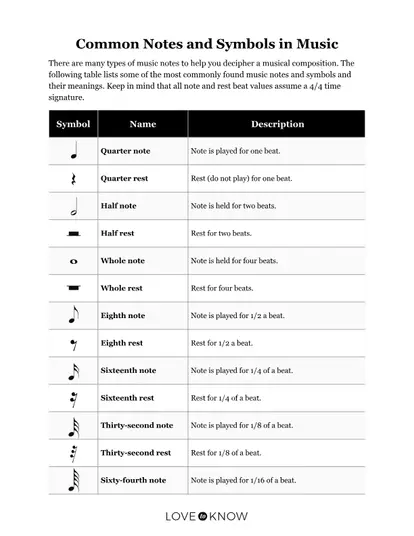
There are many types of music notes to help you decipher a musical composition. The following table lists some of the most commonly found music notes and symbols and their meanings. Keep in mind that all note and rest beat values assume a 4/4 time signature. Scroll past the main chart to find the printable version.
| Symbol | Name | Description |
| Quarter note | Note is played for one beat. | |
| Quarter rest | Rest (do not play) for one beat. | |
| Half note | Note is held for two beats. | |
| Half rest | Rest for two beats. | |
| Whole note | Note is held for four beats. | |
| Whole rest | Rest for four beats. | |
| Eighth note | Note is played for 1/2 a beat. | |
| Eighth rest | Rest for 1/2 a beat. | |
| Sixteenth note | Note is played for 1/4 of a beat. | |
| Sixteenth rest | Rest for 1/4 of a beat. | |
| Thirty-second note | Note is played for 1/8 of a beat. | |
| Thirty-second rest | Rest for 1/8 of a beat. | |
| Sixty-fourth note | Note is played for 1/16 of a beat. | |
| Sixty-fourth rest | Rest for 1/16th of a beat. | |
| Dotted note or rest | Add half the beat value of the note or rest. For example, a dotted half note equals three beats. | |
| Beamed notes | Eighth, sixteenth, thirty-second, and sixty-fourth notes may be connected in groups by a beam. This makes the notes easier to read and helps organize the music. | |
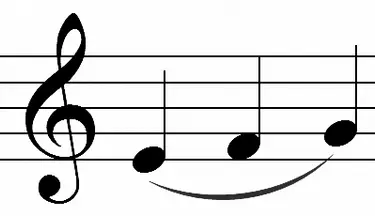
| Tied notes | A tie connects two or more notes and their beat values together. Tied notes should be played as a single note and held for the length of their combined beats. | |
| Triplets | Triplets divide one beat into three equal beats. | |
| Grace notes | A grace note is an extra note added for flare and is not a necessary part of a music composition. It does not have a specific beat value but is played rapidly prior to a valued note's beat. | |
| Broken chord | Also called an arpeggio, a broken chord symbol means to play the notes of the chord separate (from bottom to top) instead of at the same time. | |
| Staff | Consists of five lines and four spaces. Notes are written on the lines, in the spaces and above and below the staff. Each line and space represents a note on the musical scale. | |
| Bar line | A bar line divides the musical staff into measures. | |
| Treble clef | Also called the "G" clef, this symbol is found at the beginning of a music staff and represents treble notes. | |
| Bass clef | Also called the "F" clef, this symbol is found at the beginning of a music staff and represents bass notes. | |
| Key signature | The number of sharps or flats at the beginning of a musical piece that determines what key to play or sing in. | |
| Time signature | Determines the beat or rhythm of the musical piece. The top number of the time signature tells how many beats are in each measure, while the bottom number determines what type of note gets one beat. The example to the left shows a time signature of 6/8. This means there are six beats per measure and an eighth note gets one beat. | |
| Common time | This symbol indicates a time signature of 4/4 (four beats per measure, quarter note gets one beat). | |
| Cut time | Indicates a time signature of 2/2 (two beats per measure, half note gets one beat). | |
| Grand staff | When the treble and bass clef staffs are connected by a brace, this is called the grand staff. | |
| Sharp | A sharp symbol in front of a note directs you to play or sing that note one half step higher for the duration of the measure. | |
| Flat | A flat in front of a note directs you to play or sing that note one half step lower for the duration of the measure. | |
| Natural | A natural sign in front of a note cancels out a previous flat or a sharp in a measure. | |
| Piano | Play or sing softly. | |
| Pianissimo | Play or sing very softly. | |
| Pianississimo | Play or sing very, very softly. | |
| Forte | Play or sing loudly. | |
| Fortissimo | Play or sing very loudly. | |
| Fortississimo | Play or sing very, very loudly. | |
| Mezzo piano | Play or sing moderately softly. | |
| Mezzo forte | Play or sing moderately loudly. | |
| Glissando | A glissando mark between two notes tells you to quickly slide your fingers up or down the keys or strings between those notes, starting and ending on the written notes. Vocalists may also perform glissandos. | |
| Crescendo | Gradually play or sing louder. | |
| Decrescendo | Gradually play or sing softer. | |
| Staccato | Play or sing the note in a detached manner, with clear separation between notes. | |
| Marcato (accent mark) | Play or sing the note forcefully with emphasis. | |
| Legato | Also called a slur, this symbol indicates you should smoothly connect a group of notes. | |
| Breath Mark | This symbols tells a performer to take a breath. For a violinist, it means to lift the bow. | |
| Trill | To rapidly play two notes back and forth, the written note and usually the note above it. | |
| Repeat Sign | Instructs you to repeat sections of music. If a repeat sign is seen at the end of the music, go back to the beginning and play it again. | |
| Fermata | Hold the note for as long as the musician or conductor deems appropriate, usually at least twice the beat value of the note. Fermatas are often seen at the end of a musical piece. |
Free Printable Chart
If you'd like a copy of this chart to take along with you, simply click on the image below to open the .pdf file. The chart will open in a new window or tab, and from there you can download it to your computer or print out a hard copy.

Understanding the Universal Language
Music is considered the universal language because it transcends culture, nationality and traditional languages. Music notes and symbols are the foundation of the musical language. Each symbol and note adds a unique element to a musical composition and learning to read them opens the door to an unlimited world of musical opportunities and experiences.